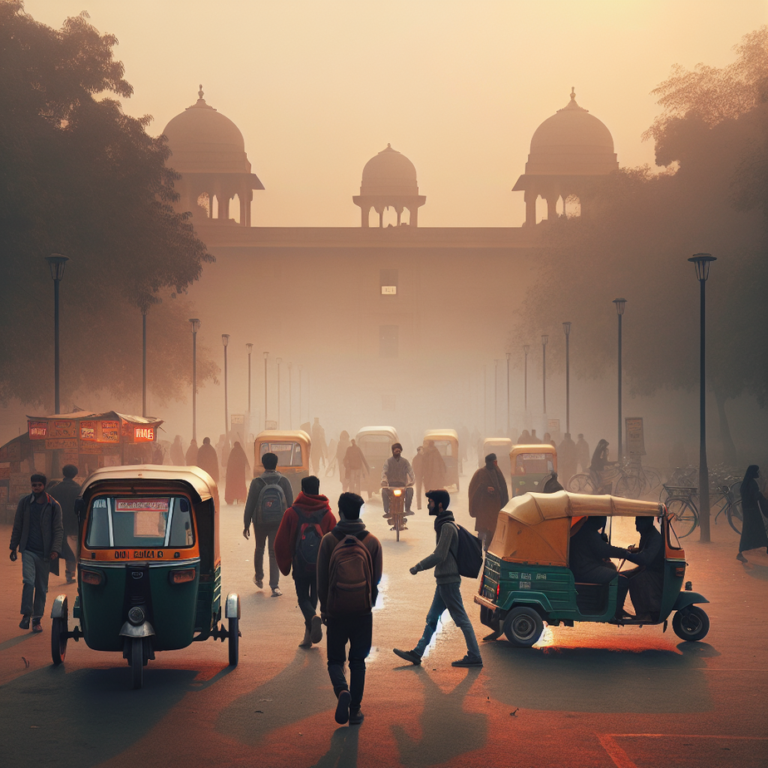
New Delhi — Think the air quality in your neighborhood is “moderate” just because the monitor near the park says so? Think again. A new parliamentary push is calling out a major imbalance in how Delhi-NCR tracks pollution — and it turns out, some areas are under surveillance, while others are flying under the radar like it’s a season of Sacred Games. If you live near Lajpat Nagar or Dwarka, your lungs may be carrying the burden of neighborhoods that just look good on paper.
Why Your Local AQI Might Be Misleading AF
Last week, a Parliamentary standing committee on science and technology flagged a critical flaw in how Delhi and NCR monitor air pollution: the distribution of air quality monitors is completely out of whack. Some areas — like upscale central zones and parts of South Delhi — are stacked with devices that measure pollutants round-the-clock. Others, especially in peripheries like Bawana, Loni, and certain belts of Faridabad and Ghaziabad, have either one monitor or none. That means while the official reports may state the city’s AQI as “Poor but stable,” certain neighborhoods could be choking without ever making it to the report highlights.
The panel is demanding a scientific redistribution of the 83-odd existing air monitors, emphasizing that the placement should be data-driven, not based on “elite-friendly” city mapping. They’ve hinted at a re-alignment over the next quarter, and there’s talk of leveraging satellite-based data to do real-time coverage mapping. The Central Pollution Control Board (CPCB) now has a deadline: submit a redistribution plan by the next parliamentary session. Finally, it seems the air of Delhi might get monitored with the kind of honesty typically reserved for college attendance sheets before fest season.
Noida’s AQI Looks Better Than It Feels — Here’s Why
For anyone who’s walked out of their office in Sector 62, Noida at 5 PM and felt their lungs do a little protest march, this isn’t news. The reallocation plan matters because it’ll correct the illusion: areas like Gurgaon’s Golf Course Road or Chanakyapuri always look cleaner because of where the monitors are placed. But get closer to Kapashera border or Anand Vihar ISBT, and it’s a different story — smoky, dusty, and nowhere on the national AQI averages. This misrepresentation affects local response systems: schools dismiss early in South Delhi while Ghaziabad’s schoolkids go to class in smog with zero alerts.
For the average Dilli walla, this means we might finally get pollution alerts that match what we actually breathe, not what shows up on our phones. It’s also likely to put more pressure on local authorities to up their game in areas previously ignored — think road dust clean-ups near Mukarba Chowk or industries around Sahibabad being forced to audit emissions more seriously. Students in DU’s North Campus and delivery guys doing rounds in Greater Noida — this redistribution could mean fewer days of throat burns and cough attacks with zero warning.
Remember When Anand Vihar Was Already on the Naughty List?
This isn’t Delhi’s first rodeo with dodgy AQI readings. Back in 2016, Anand Vihar was flagged as the most polluted part of the city with staggeringly high particulate matter. The area had three monitors back then, while nearby trans-Yamuna zones like Dilshad Garden had none. The CPCB attempted a correction by tying up with IIT Kanpur in 2019 to create predictive air models using historical AQI data. But like most Delhi projects, this didn’t scale as planned. What we’re seeing now is both a throwback and a step forward: there’s finally some political will (and data pressure) to call out these gaps and fix the coverage map so everyone — Lodhi Garden joggers and Najafgarh rickshaw drivers alike — gets a fair read.
📍 Spot Check: The redistribution plan could impact areas like Mehrauli-Badarpur Road (near Tughlakabad), Punjabi Bagh, Okhla Industrial Estate (adjacent to CRRI), and parts of Ghaziabad like Kaushambi and Mohan Nagar. Busy metro interchanges like Rajiv Chowk, HUDA City Centre, and Dilshad Garden may soon get reclassified based on more accurate pollutant metrics.
The Final Word
This move is long overdue. If your AQI app has been gaslighting you, relief might finally be on the way — but only if this rebalancing doesn’t become another file gathering dust in Ministry Bhawan. It’s a “Yay” in principle, but execution is everything. Are the powers-that-be really ready to admit that our cleanest areas might not be all that clean? Delhi: are you ready for the truth, unfiltered and un-airbrushed?
Have something to say? Drop a comment below!
#DelhiAQITruth
#SmogWatch2024
#PollutionPolitics
#NCRBreathesUneven
#LungiTightOnAirQuality
About the Author