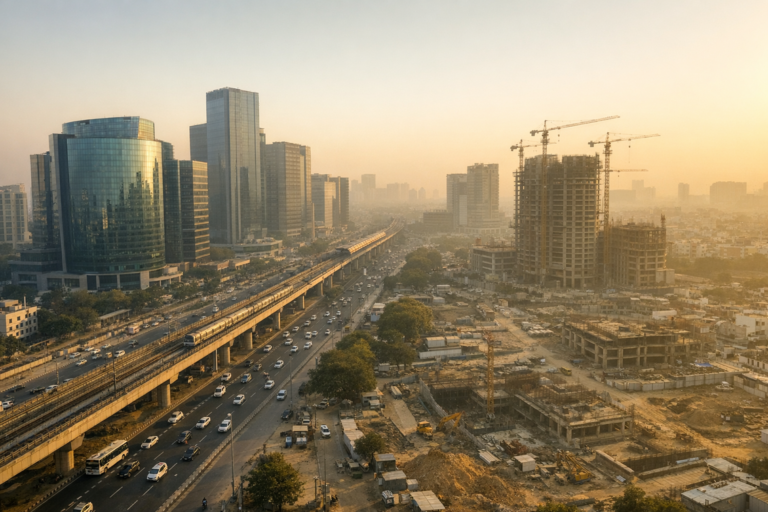
New Delhi — Ever wondered why Gurugram keeps getting new office towers while your daily commute on NH-48 somehow gets longer? Well, Haryana’s latest investment push could bring another round of changes to Delhi NCR. The state is targeting the conversion of 70% of its investment MoUs into actual projects. Sounds like typical government paperwork? Not quite. For anyone working in Cyber City, hunting for jobs in Manesar, or considering property near Dwarka Expressway, this is a development worth understanding.
Haryana’s 70% Investment Target: Big Promises, Real Projects?
Haryana is making an ambitious push to turn investment commitments into actual business activity. According to a report by The Times of India, the state is targeting the conversion of 70% of its investment Memorandums of Understanding (MoUs) into projects.
Now, here’s what that means in everyday language.
When a company signs an MoU with a state government, it essentially expresses interest in investing. The agreement might involve building a factory, opening a corporate office, establishing a logistics hub, or expanding an existing business.
However, signing an MoU doesn’t automatically mean construction starts the following morning.
Companies still need land, regulatory approvals, infrastructure connections, financing, and a commercially viable business plan.
That’s where Haryana’s 70% target becomes significant. Rather than focusing only on attracting investment announcements, the state wants a substantial share of those commitments to progress into actual projects.
For Delhi NCR, the implications could be particularly important.
Gurugram already hosts major corporate offices, technology companies, financial services firms, and commercial developments. Manesar has a strong industrial base, while areas around Sohna and the Kundli-Manesar-Palwal Expressway offer additional opportunities for manufacturing and logistics.
If investment commitments turn into operating businesses, these locations could see greater demand for workers, transport services, housing, and supporting businesses.
But there’s an important distinction: 70% is a conversion target, not a confirmed achievement. The headline alone doesn’t establish how many MoUs have already become operational projects, how much money has actually been invested, or when new facilities will open.
Those details matter far more than the announcement itself.
From Cyber City to Manesar: What Changes for Delhi NCR Locals?
For Delhi NCR residents, the biggest question isn’t how many investment agreements Haryana signs. It’s whether those agreements create better jobs, improve infrastructure, and make everyday life easier.
Consider someone living in Janakpuri and commuting to Gurugram. A new corporate campus could mean additional employment opportunities. But if thousands of workers start travelling along the same already-crowded routes, commuting conditions might become more difficult.
Anyone familiar with the morning rush around IFFCO Chowk knows the feeling. Traffic builds near major junctions, office cabs compete for space, and the short distance between two signals can take surprisingly long.
Residents frequently describe NH-48’s peak-hour congestion in similar terms: “The office is nearby on the map, but reaching it is the real problem.”
That’s a familiar commuter sentiment, not a verified interview.
For students at Delhi University or engineering colleges across NCR, successful investment projects could eventually create internships, graduate hiring opportunities, and technical roles.
For families living around Dwarka Expressway, New Gurugram, or Sohna Road, additional commercial development might support neighbourhood services and housing demand. However, higher demand doesn’t guarantee better affordability.
Local businesses could benefit too. A functioning office campus needs food vendors, stationery suppliers, maintenance teams, transport operators, and nearby restaurants.
Still, these benefits depend on projects actually opening and employing people.
Why Gurugram Became NCR’s Corporate Magnet in the First Place
To understand Haryana’s latest investment ambitions, it’s worth remembering how Gurugram transformed over the past few decades.
There was a time when much of today’s corporate Gurugram consisted of agricultural land, villages, and relatively limited commercial development.
Delhi remained the region’s traditional centre for government offices, established markets, and major institutions.
But as businesses expanded, land availability and development opportunities became increasingly important.
Gurugram benefited from its proximity to Delhi, access to the airport corridor, private commercial development, and the arrival of multinational companies.
Areas such as DLF Cyber City, Golf Course Road, and Udyog Vihar gradually developed distinct business identities.
Meanwhile, Manesar strengthened its position as a manufacturing and industrial location.
The Delhi Metro’s Yellow Line, including stations such as Sikanderpur and Millennium City Centre Gurugram, improved access to parts of the city, although many employment centres still depend heavily on road transport.
Noida followed a different development path, building its own technology, commercial, and industrial corridors in Uttar Pradesh.
Today, companies considering NCR locations can evaluate options across Delhi, Haryana, and Uttar Pradesh.
Haryana’s challenge is therefore not simply attracting investors. It must demonstrate that projects can move from announcements to execution without excessive delays.
That means dependable infrastructure, practical approvals, available workers, and competitive operating costs.
Planning a Job, Business or Home? Here’s What to Do Next
- Job seekers: Track actual hiring, not investment headlines. If you’re a graduate from Delhi University, an engineering student, or someone planning a career switch, monitor company career pages and verified openings around Cyber City, Udyog Vihar, IMT Manesar, and Sohna. Follow Haryana government investment announcements, but wait for confirmed project locations and recruitment notices before making career decisions. Never pay an agent who promises employment simply because a new investment project has been announced.
- Daily commuters: Check the complete journey before accepting an offer. A job in Gurugram might look attractive until you calculate travel time from Rohini, Rajouri Garden, or Dwarka. Use Delhi Metro’s official route information to identify connections through the Yellow Line and Rapid Metro. If the workplace is in Manesar or beyond convenient metro access, ask employers about shuttle services, cab facilities, and flexible working hours. Test the route during your expected office timings rather than relying only on weekend travel estimates.
- Homebuyers and small businesses: Verify development on the ground. If you’re considering property near Dwarka Expressway, Sohna Road, or New Gurugram, don’t purchase solely because an investment announcement sounds promising. Check Haryana RERA registration details, project approvals, construction progress, water supply arrangements, and actual road connectivity. Small business owners should also study nearby office occupancy and customer demand before signing expensive commercial leases. A proposed industrial park doesn’t automatically guarantee immediate footfall.
📍 Spot Check: For a practical understanding of Haryana’s investment geography, look at DLF Cyber City near Cyber City Rapid Metro station, Udyog Vihar near the Delhi-Gurugram border, and the industrial areas of IMT Manesar along the NH-48 corridor. IFFCO Chowk and Millennium City Centre Gurugram are useful reference points for understanding office connectivity, while Dwarka Expressway links developing residential and commercial areas with the wider NCR road network. These are established regional landmarks, not a confirmed list of locations for the newly targeted investment projects.
The Final Word
Haryana’s ambition to convert 70% of investment MoUs into projects deserves attention, especially from people whose careers and businesses depend on Delhi NCR’s economic growth.
People Also Ask
Is this officially confirmed?
Yes, but implementation on ground may vary.
Who benefits the most?
Daily commuters, students and small shop owners.
Any hidden catch?
Check timings & local enforcement.
But investment announcements should be judged by results, not impressive percentages.
For Gurugram residents, real progress would mean more quality jobs without unbearable traffic. For Manesar workers, it could mean stronger industrial employment and better transport connections. For families considering a move, it should mean reliable infrastructure rather than just another cluster of expensive apartments.
The next thing worth watching is whether Haryana publishes measurable progress on project approvals, construction, investment realised, and employment generated.
Because in Delhi NCR, we’ve seen enough ambitious plans on paper. What matters is what actually gets built.
Would you welcome more corporate and industrial projects in Gurugram, or should Haryana fix traffic and infrastructure before encouraging further expansion?
Have something to say? Drop a comment below!
#Delhi #Gurgaon #HaryanaInvestment #NCRJobs #BusinessNews
About the Author